How it works
How it would be built
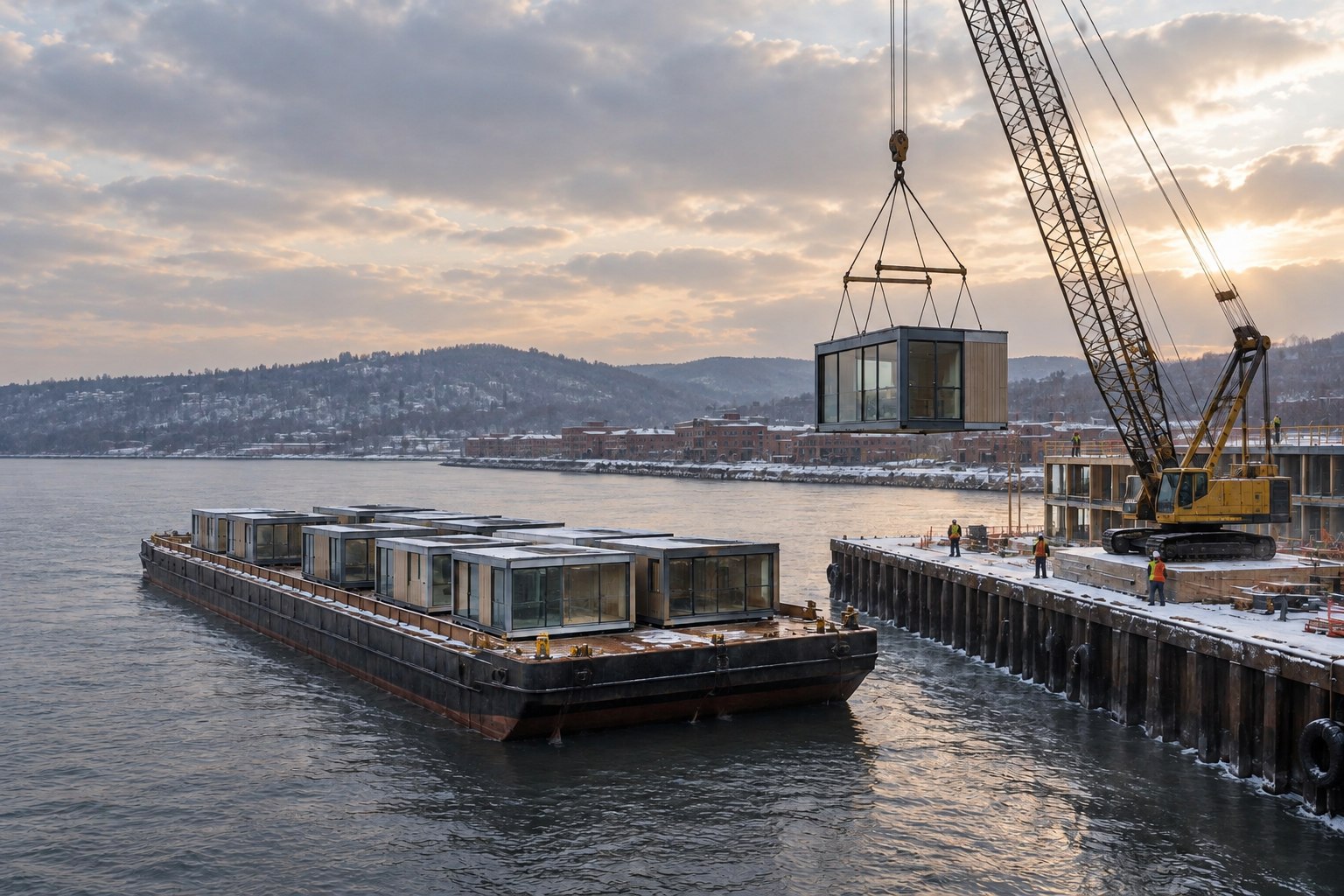 Conceptual illustration
Barge delivery steps
From the factory to East Strand
- 1
Factory checks
Modules would be built, wired, plumbed, and pressure-tested in a factory.
- 2
Barge
Modules would be loaded at a port and towed to the Rondout.
- 3
Heavy-lift terminal
A temporary landing and crane pads would receive modules from the barge.
- 4
Prepared foundations
Piles, slabs, and utility connections would be prepared while modules were being built.
- 5
Install and test
Modules would be lifted into place, connected, and tested.
01
What would be modular
| Element | Module approach |
|---|---|
| Data halls | Liquid-cooled compute modules with integrated electrical and cooling skids |
| Energy center | Fuel-cell modules, battery containers on a separate lot, heat-exchanger modules |
| Hillside housing | Volumetric modules, if housing partners choose them |
| Restaurants & studios | Shell modules fitted out by independent tenants |
| Glasshouses | Prefabricated Dutch-style structure and climate systems |
| Marina | Floating pontoons and utility pedestals |
| Vessel conversions | Historic boats refitted off site as Boatel rooms |
02
Connections and exterior design
Standard connections for power, water, heat, data, and structure would let modules be replaced, upgraded, or reused. Gables, brick, timber, and varied colors would give buildings individual fronts, drawing on Nyhavn.
03
Barge delivery checks
Navigation: we would check channel depth, width, tides, and seasonal ice in Rondout Creek. Bulkheads and cranes: studies would test existing quay walls and any new structures for crane loads. Bridge clearance: any upstream route would need overhead checks.
Flooding: raised pile platforms would leave space underneath for floodwater. Critical equipment would sit above FEMA flood elevations, allowing for sea-level rise.
Permits: work in navigable waters would generally need US Army Corps of Engineers and NYSDEC approval. Fallback: if barge delivery proved unworkable, smaller modules would arrive by truck under locally agreed traffic plans.