Daily life
Growing food with the heat
 Conceptual illustration
01
Choose crops with buyers
Regional chefs, culinary schools, and specialty distributors would help choose crops and set quality standards. We would seek forward purchase commitments before adding bays.
The Hudson Valley has a strong restaurant trade, with the Culinary Institute of America nearby in Hyde Park. Local growing could improve the quality of delicate ingredients that travel poorly.
No chef, school or distributor has committed. These are the relationships we would seek.
02
Priority crops and trials
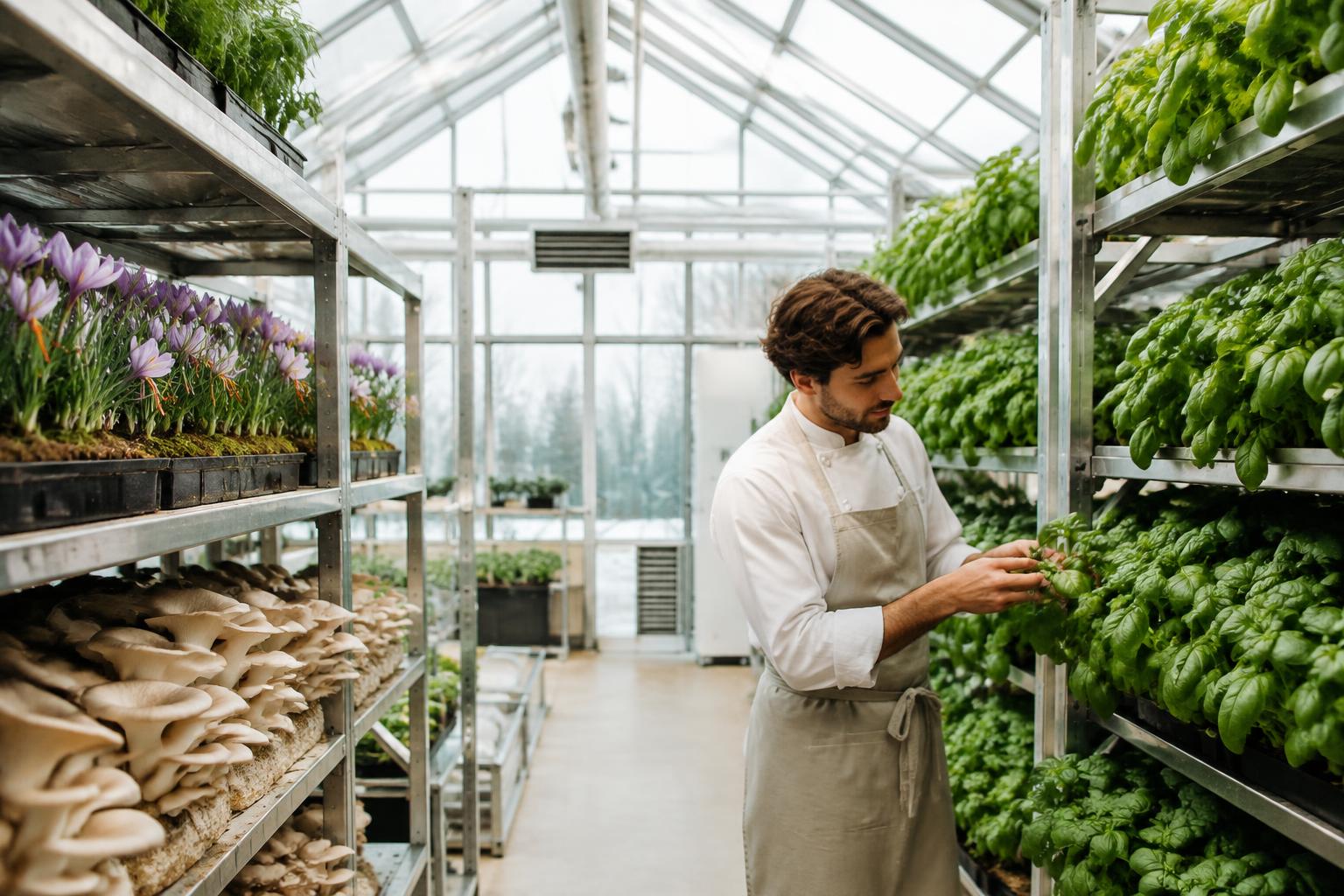
Priority crops: edible flowers, microgreens, shiso, specialty herbs, and premium peppers would be sold fresh. Their high value and short cycles would guide crop planning. Specialty mushrooms would use agricultural by-products in separate dark, humid rooms.
Experimental only: saffron, wasabi, and vanilla are difficult crops with long payback periods. Small-room trials would have no commercial expectation.
| Crop group | Growing space | Cycle | Why here |
|---|---|---|---|
| Microgreens | Closed grow room, vertical racks | 1–3 weeks | Very fast turnover; chefs want them fresh daily |
| Edible flowers | Glasshouse bay | Continuous harvest | Fragile, high value, hard to ship |
| Shiso & specialty herbs | Glasshouse bay or grow room | Continuous harvest | Winter supply gap for fresh herbs |
| Premium peppers | Glasshouse bay, high-wire | Long season | Benefits most from steady heat and CO₂ |
| Specialty mushrooms | Separate climate rooms | Several weeks per flush | Steady warmth and humidity; low light |
| Saffron, wasabi, vanilla | Small trial rooms | Months to years | Experimental only |
03
Factory-built bays and grow rooms
Prefabricated Dutch-style bays would arrive by barge and bolt together on prepared foundations. They would use standard steel frames, glass panels, screens, and vents. Modular climate-controlled rooms would hold hydroponic racks for herbs and microgreens.
Automatic fertigation would dose water and nutrients to each zone. Sensors would track temperature, humidity, CO₂, and light. LEDs would fill daylight gaps, and software would schedule sowing around orders.
Robots would move benches, seed trays, or harvest only where their cost was justified.
- 1
Data hall heat
Warm water at about 35–50 °C (assumed until the equipment is specified) would pass from liquid-cooled chips through an isolated loop.
- 2
Heat pumps & storage
Heat pumps would raise temperatures; tanks would store heat for cold nights. Electric backup would protect crops.
- 3
Bays & grow rooms
Glasshouse bays, enclosed herb rooms, and separate mushroom rooms would each have their own climate.
- 4
Chefs & kitchens
Crops would be harvested to order for restaurants, culinary schools, and specialty distributors.
- 5
Measured & reported
Useful heat, supplied and absorbed CO₂, water, energy, and lifecycle emissions would be reported separately.
04
Heat, water and backup
Warm water from liquid-cooled chips would pass through heat exchangers to heat glasshouses. Heat pumps would raise temperatures where needed, and storage would balance day, night, and seasonal demand. Electric backup would protect crops during data hall outages, without combustion stacks.
Irrigation would use an independent food-safe water loop with drinking water or properly treated water. It would stay separate from data hall cooling and wastewater loops. Treated captured rainwater could add supply.
Crops would use added CO₂, then release most of it after harvest.
05
CO₂ for crop growth
Greenhouses use added CO₂ to raise yields. Fuel-cell exhaust is more concentrated than engine exhaust, but captured CO₂ would need food-safety and contaminant checks. Raw exhaust would never enter growing rooms, and commercial food-grade CO₂ would be the fallback.
Estimated plant uptake would be well under 1% of district emissions. Enrichment would be a crop input, with no carbon credit claimed.
Using CO₂ for crops would not provide durable carbon storage. Most carbon in harvested herbs, peppers, and mushrooms returns to air within weeks or months after eating or composting. We would make no permanent removal claim without verified durable storage.
We would measure separately: useful heat actually delivered, CO₂ supplied and estimated plant uptake, heating fuel avoided, water used, and lifecycle emissions of the greenhouse itself.
06
How the economics work
We would check yield per m², realized price after discounts and waste, and annual crop cycles. Costs would include energy and lighting, labor, packaging, spoilage, and capital cost. Contracted demand would be central.
Recovered heat would help, though labor and selling price would usually matter more.
We publish no financial projections. The calculator shows heat, water, CO₂, harvest, and the share of pilot heat a glasshouse could use.
Physical-resource estimate
Greenhouse resource calculator
This estimates a glasshouse's heat, water, and CO₂ use, including its share of recoverable pilot heat. Defaults are assumed, with no measured results. No prices or returns are shown.
Pilot heat assumes 4.8 MW of computing (IT load) at 90% average load and 80% recovery (30,275 MWh/yr). Heat used here could not also count toward homes, other buildings, or the wastewater plant. Supplied CO₂ would be used by crops, without permanent removal.
Most would return to air after eating or composting.
07
Checks before adding bays
We would add bays only after crop quality, buyer demand, and margins had met the previous bay's targets.
- 1
Chef panel
Chefs and buyers would choose crops and sign letters of intent before construction.
- 2
Pilot bay
One prefabricated bay and one grow room would test priority crops for a full year.
- 3
Prove the crop
Yield, quality, shelf life, and food safety would be measured against targets.
- 4
Prove the margin
Realized prices, labor, and energy would be compared with the model and published.
- 5
Add bays
Expansion would require forward purchase commitments and positive margins.
08
Local jobs and training
Operations would create local jobs for growers, technicians, food-safety staff, and logistics workers. Local schools could help with training if they chose to participate. The goal would be good food and a lasting business.